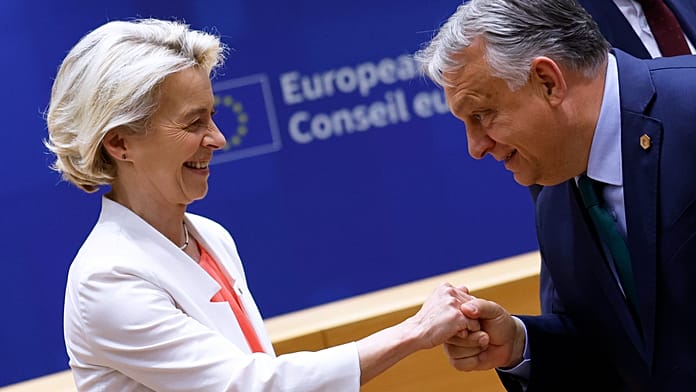
The European Commission has effectively stopped making decisions over files related to Hungary, two sources familiar with the matter told Euronews.
The reason for putting sensitive decisions on hold is simple: the Commission does not want to be seen as interfering in the Hungarian election campaign and does not want to give ammunition to Orbán’s anti-EU rhetoric during the hot phase of campaigning.
“With the Hungarian dossiers, the front lines are frozen, and nothing is happening. The Commission is waiting for April to happen and is watching opinion polls in Hungary very closely,” an EU diplomat told Euronews, speaking on condition of anonymity.
Hungary will hold Parliamentary elections in mid-April that could see Orbán lose his grip on power. The opposition Tisza Party, led by Péter Magyar, is leading in the opinion polls ahead of Orbán’s Fidesz-KDNP coalition even if the gap between the two is narrowing.
Orbán is running a campaign in which he often portrays Hungary as a victim of a campaign led by Brussels “bureaucrats pushing for war, gender ideology and open borders” to allow migrants into the continent.
“We don’t want to play into his hand”, the source added, and opening or implementing infringement procedures could fuel that rhetoric. Orbán regularly slams EU sanctions against Hungary and uses them to lambast European policymakers.
The European Court of Justice fined Hungary a daily penalty for breaking EU asylum rules in 2024. Still, Orbán has repeatedly argued that sanctions are worth paying to “keep Hungary safe”.
“We pay €1 million a day. That’s how much we’re being punished for the border fence we built 10 years ago. A lot of money, but it’s the best investment for our future,” Orbán wrote on social media in July. He repeated the same during his trip to Washington as he sought to emulate Trump’s hardline politics on illegal migration.
No legal action yet on the Budapest Pride Ban
The Commission’s inaction around the banned Budapest Pride is particularly problematic after the head of Commission Ursula von der Leyen declared herself as ally of the LGTBQ+ community after the pride came under immense pressure from the Hungarian government last year.
Last March, the Hungarian Parliament passed a law last March, effectively forbidding participation in Pride, threatening with a fine and smart camera supervision. At the time, NGO’s and activists called the legislation discriminatory and demanded EU action.
The legal text is a 3-page addition to the assembly law, but so far, the Commission has not finished with the legal evaluation of the text and has not announced legal steps.
The Budapest Pride went ahead despite the ban from the government, backed by the mayor of the city Gergely Karácsony. Karácsony, talking to Euronews in October, described the European Commission’s inaction as a political decision.
“It was obvious from the first minute that this is completely contrary to European Community law. I am trying to understand why there is no political will to go against this. Maybe they are waiting, or maybe they are afraid that this process will drag on, and they do not want to influence the parliamentary election,” Gergely Karácsony said.
By contrast, the Commission was not reluctant to act on a Slovak constitutional amendment stating that there are only two sexes – male and female. The Commission triggered an infringement procedure against Slovakia in November last year.
Brussels delays inquiry into Hungary spying allegation
Last October, Hungary’s permanent representation in Brussels became the centre of a scandal alleging that officials connected to the Orbán government ordered its civil servants to use the premises to spy and gather intelligence on sensitive files handled by the Commission in relation to Budapest.
The alleged spy ring, operational between 2012 and 2018 also tried to recruit Hungarian nationals working for the EU institutions.
The Commission did set up an internal inquiry to clarify the role of Health Commissioner Olivér Várhelyi, who was Hungary’s EU ambassador at the time the spy ring was operational and has worked closely with Orbán, but little came out of it.
The Commission originally planned to release the findings before Christmas, but Euronews understands this proceeding is also delayed, possibly even beyond the election date.
Commission officials who spoke to Euronews also suggested that a probe that would lead to the exit of Várhelyi could end up creating a bigger mess, as the Hungarian Commission handles a small portfolio relative to his counterparts, is technical and for the most part keeps to himself.
A replacement could be much harder to deal with, one person said.
Várhelyi has denied any allegations of wrongdoing or spying on behalf of the Hungarian authorities.
Financial decisions related to funds for Hungary on hold
Hungary requested the regrouping of around 4 billion euros under the EU’s Recovery and Resilience Facility (RRF) last December under the Hungarian Development Bank.
By doing it through its state investment arm, Hungary could technically fulfil the spending criteria and avoid losing this amount of funds. But the Commission is also reluctant to make a decision on the file ahead of the April vote.
The EU has frozen most of the EU funds for Hungary because of rule of law issues. It has lost more than one €1 billion as successive deadlines to execute the cash went by at the end of 2025.
The European Parliament has also called for more financial freezes and the suspension of Hungary’s voting rights in its resolution in its Article 7 review voted last November.
According to MEP Daniel Freund, the EU made a strategic mistake by not taking action even at the risk of instrumentalisation during an election campaign.
“Strategically, the idea of not interfering is really bad,” he told Euronews. “There’s no such thing as suspending the EU treaties because there is an election campaign.”
The German politician and member of the Green party said the EU should call out what he describes as the “lies of the Hungarian government” rather than playing coy, which he argues could come back to haunt the European institutions the “same way the principle of non-interference did during and after the Brexit vote.”
Is Brussels waiting for Magyar to smooth the ties with the EU?
Brussels has a lot at stake with the Hungarian elections in April.
Viktor Orbán, in power since 2010 with a super majority, is fundamentally opposed to key European legislative files, from financial support to Ukraine, to sanctions and the common migration rules that apply to all 27 member states.
His policy of veto, which the Hungarian government now uses de facto in every vote, has also created huge internal tensions within the EU where unanimity if often needed for policy decisions, particularly when it comes to European foreign policy.
His opponent, Péter Magyar, is a much younger conservative, a former ally and currently a member of the European People’s Party, and the centre-right political group that dominates both the European Council and the European Parliament.
Magyar is seen as a more pro-European politician, who could rebuild the broken Budapest-Brussels relation under Orbán and could lead to the release of EU funding in similar ways to the return of the Donald Tusk in Poland.
A source from the European Parliament, talking to Euronews on condition of anonymity, said that Tisza and EPP are contributing to the EU’s silence on Hungarian files.
“Even the Hungary-hawks inside the EPP are saying ‘let’s do nothing’, because Orbán will misuse it in the campaign for Brussels-bashing. It’s a mistake,” the Parliamentary source said.
There is one file, however, where the Commission is ready to work with Orbán; and that is the defence spending. Under the Security Action for Europe (SAFE), the EU decided last May to allocate €16 billion for Budapest, which is the third biggest amount among member states, signaling that security is an area where consensus trumps politics.