Published on
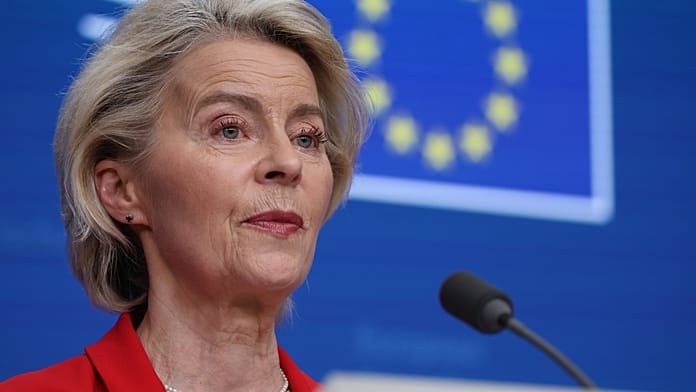
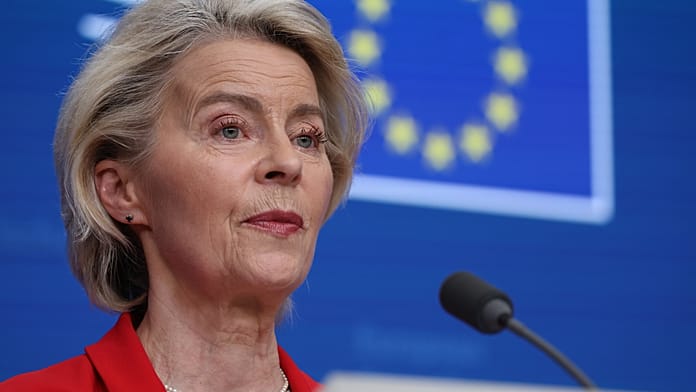
Ursula von der Leyen has suggested countries willing to work on economic matters should go ahead in smaller groups if unanimity cannot be found ahead of a key summit focused on bolstering the European economy squeezed between the US and China.
The head of the European Commission said the goal remains to push through an “ambitious” economic agenda agreed by all 27 member states, but if that is not possible due to political differences, member states should turn to smaller coalitions.
Her comments come after Mario Draghi, one of the most influential voices in the European debate, called on the EU to work as a true union and urged European leaders to enact a “pragmatic” federalist approach for common projects from energy to security.
“Our ambition should always be to reach agreement among all 27 member states,” von der Leyen wrote in a letter addressed to leaders on Monday.
“However, where a lack of progress or ambition risks undermining Europe’s competitiveness or capacity to act, we should not shy away from using the possibilities foreseen in the treaties under enhances cooperation.”
The principle of enhanced cooperation allows member states, provided a minimum of nine countries can agree, to deepen integration without the rest of member states.
Von der Leyen’s comments marks a significant departure from the principle of consensus that guides the EU institutions and opens the door to a two-speed Europe.
European leaders will gather for an informal retreat on Thursday at Alden Biesen Castle.
Draghi will join the 27 alongside former Italian prime minister Enrico Letta.
In the run-up to the meeting, European Council President António Costa told Euronews the retreat would serve to focus minds on the implementation of the Draghi and Letta reports published in 2024 and provide “clear political guidelines” for leaders.
Ahead of the summit, a group of 10 countries will meet at the invitation of Germany, Italy and Belgium to establish a common line. France will participate, according to a diplomat.
In her letter, von der Leyen said the Commission looks to accelerate its simplification agenda but urged co-legislators in the European Parliament to be constructive.
She also wrote the executive will launch a new initiative to roll back on “gold-plating” which sees member states adding more bureaucracy on top of existing EU directives.
European companies have long criticised the practice arguing that it increases costs and creates regulatory confusion for businesses operating in Europe.
With additional reporting by Mared Gwyn Jones