Published on
European leaders called on Wednesday for increased pressure on Moscow following US-Russia talks in which Vladimir Putin appeared to have made no concession to end the conflict in Ukraine.
“Until I see anything different, then I’m going to continue to draw the conclusion that Russia does not want peace,” Sweden’s Maria Malmer Stenegard told reporters upon arriving at a meeting of NATO foreign ministers.
“That is why we need to stick to the two-point plan – increase the support to Ukraine and increase the pressure on Russia – and we need to hit them where it hurts most, and that is the oil and gas revenues,” she added.
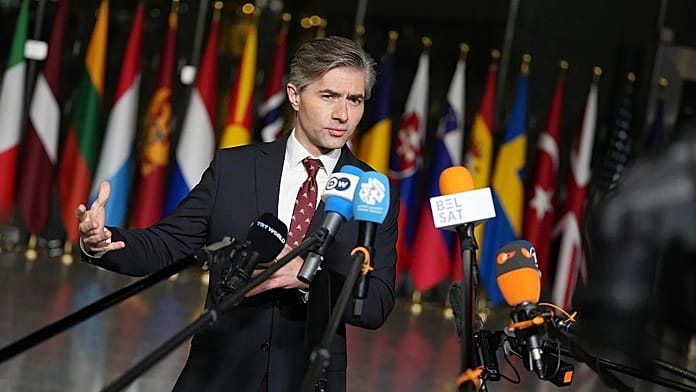
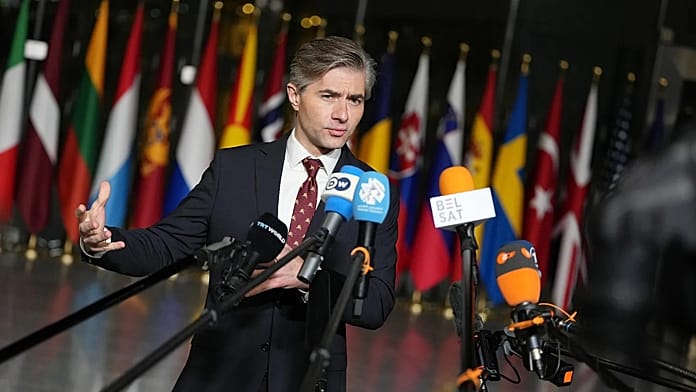
The NATO ministerial summit, which United States Secretary of State Marco Rubio is skipping, comes a day after Russian President Vladimir Putin welcomed Donald Trump’s special envoy Steve Witkoff and his son-in-law Jared Kushner for talks on ending the war in Ukraine.
The latest round of talks came after the leak of a new peace plan proposal hammered out between Washington and Moscow that shocked Ukrainians and Europeans alike with its heavily pro-Russian tilt.
This set off a new flurry of diplomatic contacts across Europe, with Ukrainian negotiators also meeting with Witkoff to refine the plan before the Moscow meet-up.
Foreign ministers meeting in Brussels on Wednesday said they had not yet been debriefed after the talks, which the Kremlin described as “constructive”, but they took the view that Putin appeared to have stuck to his usual delaying tactic.
US and Russian representatives have held several rounds of negotiations since Trump reopened channels of communication with Putin in February, with the two men meeting over the summer in Alaska. A second such summit was canned by Washington after Russia stuck to its maximalist demands.
“We see that the United States are engaged in the process, they put the diplomatic efforts to achieve a long-lasting peace,” Lithuania’s Kęstutis Budrys told reporters upon arriving at a meeting of NATO foreign ministers.
“What hasn’t changed during this half a year is Russia’s position,” he said. “They’re absolutely not interested in either ceasefire or peace agreement, and they continue to do what they are doing. So for us this is the reason to prepare the finances (for Ukraine) for the next year.”
Finland’s Elina Valtonen echoed the analysis, telling reporters that “so far we haven’t seen any concessions from the side of the aggressor, which is Russia”.
The Estonian minister, Margus Tsahkna, agreed: “From our perspective, what we see is that Putin has not changed any goals (…) that’s why the way to put more restrictions on Ukraine is the wrong way. Actually we must put more pressure on Russia,” he said.
“This is exactly what we are going to discuss today: what can we do more?”
All three countries back using some of the nearly €200 billion in frozen Russian Central Bank assets to create a so-called “reparations loan” to provide financing to Ukraine for the next two years.
The proposal, made at the EU level, is being blocked by Belgium, where the bulk of the assets are currently held.
For Estonia’s Tsahkna, the scheme is the “leverage” Europe has to “actually putting itself around the table to negotiate what kind of deal will be in the future”.
“Putin cannot decide over us. And as well, (the) US cannot make decisions instead of us,” he said.
But Maxime Prévot, Belgium’s foreign minister, doubled down on his country’s opposition to the reparations loan, describing it “as the worst” option on the table that “entails consequential economic, financial and legal risks”.
“We are not seeking to antagonise our partners or Ukraine; we are simply seeking to avoid potentially disastrous consequences for a Member State that is being asked to show solidarity without being offered the same solidarity in return,” he added.
The European Commission is expected to release later on Wednesday its legal proposal on the options it has previously identified to finance Ukraine’s needs, including the reparations loan.